

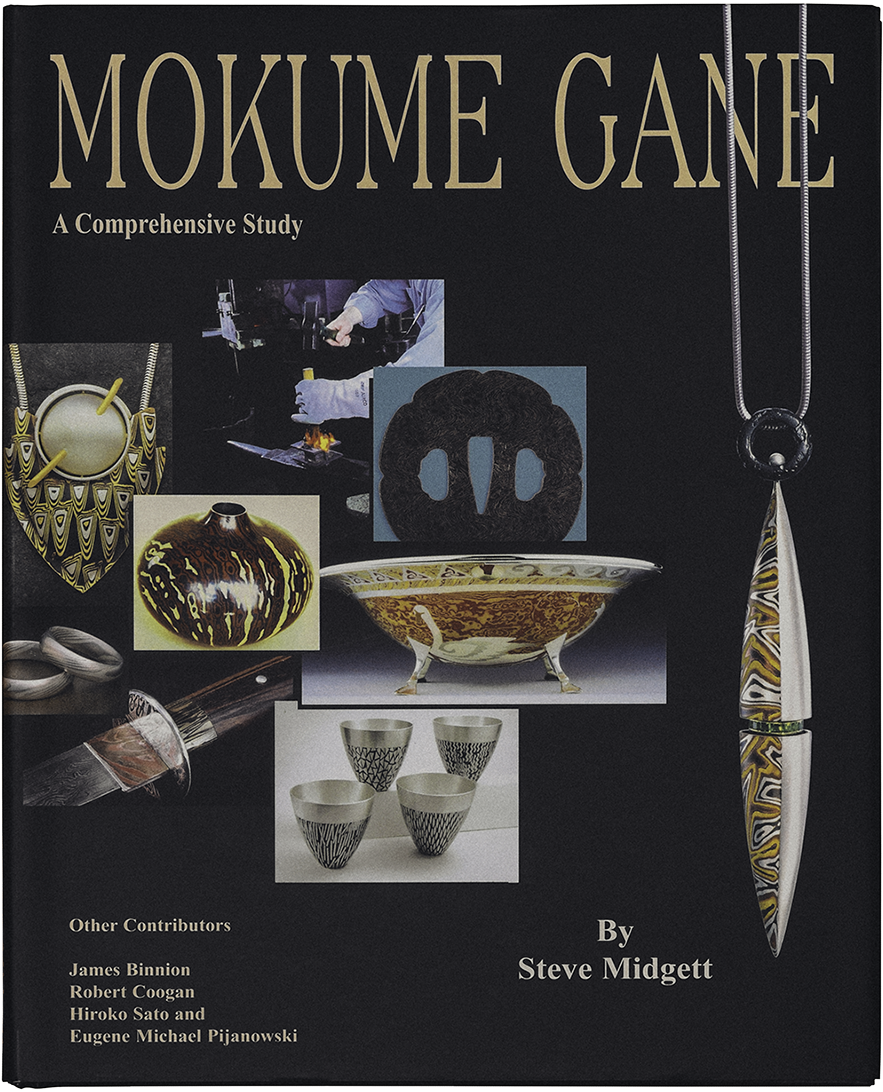
MOKUME GANE: A COMPREHENSIVE STUDY
By SteveN Midgett

TABLE OF CONTENTS
Thank you for reading! This book will be released in blog format over the next few months (please subscribe for updates). You can navigate chapters through the below table of contents or the forward and back arrows at the bottom of each post.
Mokume Gane — A Comprehensive Study | Introduction
Steven Midgett is internationally recognized as a leading authority on the subject of mokume gane. His fascination with this technique spans three decades, and his company, Steven Jacob, has specialized in mokume jewelry since 1989.

The History of Mokume Gane | Part ONE
There are actually two histories to the development of mokume gane. The first has its beginnings in Feudal Japan, obscured by time and the secretive nature by which knowledge of this kind has passed from master to apprentice through the centuries.

THE HISTORY OF MOKUME GANE | Part TWO
Armed with their newly acquired knowledge of diffusion-welded mokume gane, the Pijanowskis came back to America to continue their pioneering work in the field.

Mokume Gane Basics
There are many different approaches to the creation of mokume gane, and while most serious craftsmen working in this medium have their own favorite way, they share many similarities.

METALS FOR MOKUME
Let’s begin with a discussion of the metals used for mokume. They are divided, quite naturally, into four main groups:

Metallurgical Theory for Mokume Gane
The layers of a mokume billet should be completely and permanently bonded into a single unit, while retaining very clearly defined color boundaries. Any third alloy formed during the bonding process from the parent metals, should be kept to an absolute minimum, so as not to blur or muddy the demarcation between the metal layers.

Tools and Equipment
You will need some basic tools to create mokume by the processes outlined in this book. Many of them are common to each approach.

Preparing the Billet
No matter what firing method you use to laminate mokume, the first step in preparing a billet is to decide on the number of layers in the stack.

Firing Methods | Part one
This section of the book will cover the specific bonding methods developed and used by Robert Coogan, James Binnion and myself, Steve Midgett.

FIRING METHODS | PART TWO
I learned the basic process of Mokume-Gane from Gene and Hiroko Pijanowski in the late 1970s. We fired our billets in a traditional blacksmith's coal forge and created an oven by bricking up the edges and layering a plate of steel on top to reflect the heat back into the chamber.

Firing Methods | Part Three
With the advent of digital temperature-controllers, it has become possible to make mokume gane in a different fashion. Digital temperature control allows a kiln to be set to an exact temperature and held at that point, plus or minus a couple of degrees.

Firing Methods | Part Four
As discussed earlier in this book, there are some inherent problems associated with soldered mokume but, the familiarity of the techniques used to produce it, and minimal prep time, make this technique an attractive way to start.

From Billet to Sheet
The first thing to do with the rough billet is to gently forge it. You should reduce the thickness by about 15% of its original size. This helps to reduce the size of the internal grain structure and will make rolling out the billet much easier.

Patterning
In this chapter the basic patterning techniques are discussed. Use these as starting points for developing patterns unique to your own work. You can, of course, combine these techniques to fine-tune your control, and to enhance the pattern according to your every whim.

Finishing Techniques
Putting the final finish on a piece of mokume gane is one of the most exciting parts of the process. It is only after all your labors to create the show stopper, the prize winner, the grant getter, that you will finally see it in all its true splendor…

Project Demonstrations — Step by Step
The next section includes five demonstration projects that will introduce you to some basic ways of using mokume. Each project is designed to teach one or more skills for working with mokume and builds on its predecessor.

Project 1: Mokume Accent Ring
Make a Simple Cast Ring Accented with a Piece of Mokume Stock
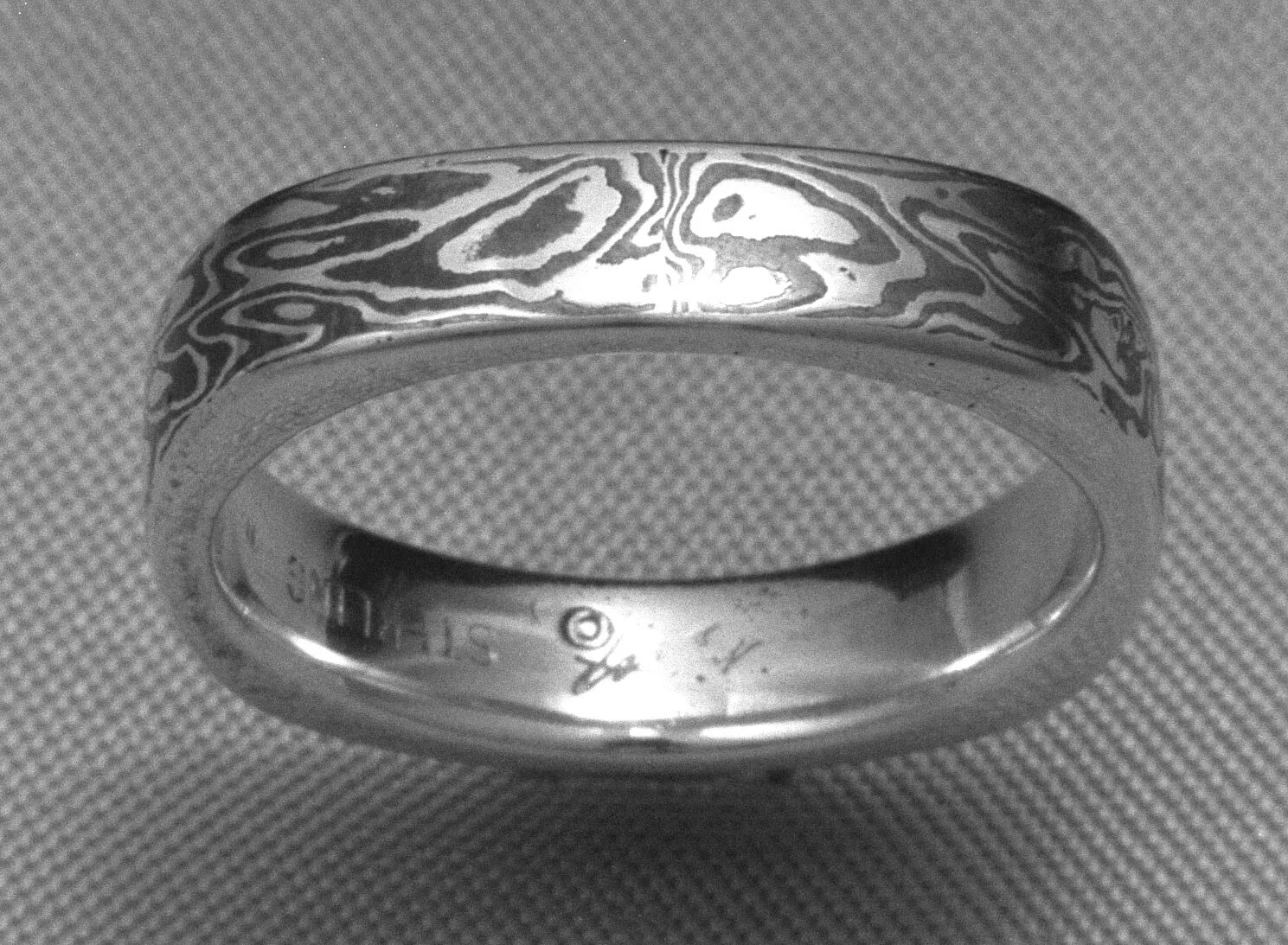

Project 3: Fabricated Mokume Band
Construction Techniques for a Mokume Band with a Liner and Edging